Open any feed right now and you’ll see it. Grainy mirror selfies. That orange-tinted filter everyone forgot existed. Captions that say some version of “heard it was 2016 again?”
It’s not a glitch. It’s not your algorithm malfunctioning. It’s a full-blown movement, and somehow nobody planned it.
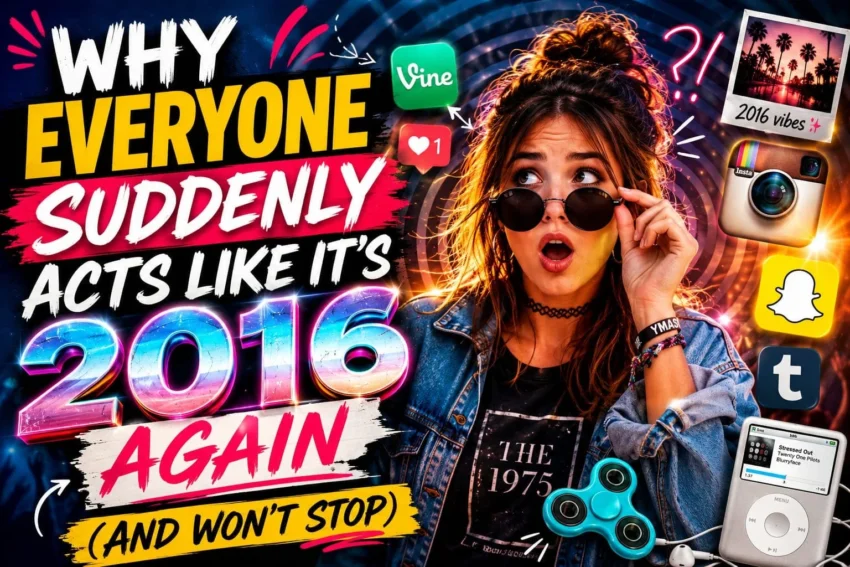
The phrase making the rounds is simple: 2026 is the new 2016. And once you notice it, you can’t stop seeing it.
So what actually happened here? Why did an entire decade-old year suddenly become the internet’s comfort blanket?
It started with one TikTok account
A user going by @taybrafang stitched together a montage of old viral clips — bottle flips, fidget spinners, the dab — and posted it with a caption joking that the internet wanted its old vibes back.
That should have been a tiny, forgettable post. Instead, it cracked something open.
Within days, the hashtag had over 1.7 million posts on TikTok alone. Not because of one influencer. Because millions of people independently looked at their own camera rolls and thought: yeah, actually, I miss this.
Then the celebrities showed up
This is usually where internet trends die — once it’s “for the algorithm,” the soul drains out of it. Not this time.
Charlie Puth posted himself lip-syncing to his decade-old duet with Selena Gomez, captioned “Heard it was 2016 again?” Hailey Bieber filmed herself and Kendall Jenner mouthing along to a song most people had genuinely forgotten existed. These weren’t polished, planned campaigns. They looked like people going through old phone storage at 1am and getting hit with a wave of something.
That’s the part that makes this trend different from the usual manufactured viral moment. Nobody’s selling anything. There’s no product tie-in, no brand partnership driving it. It’s just collective nostalgia, moving faster than anyone can monetize it.
Why 2016 specifically?
Here’s where it gets interesting — and slightly sad, depending on how you look at it.
2016 wasn’t actually a calm year. If you remember it accurately, it was politically chaotic and constantly online in a way that felt new and a little scary at the time. But somehow, a decade of distance has sanded all of that down. What’s left in the collective memory isn’t the chaos — it’s the music, the filters, the feeling of being young enough that none of it mattered yet.
One widely shared explainer put it simply: people aren’t actually craving 2016 the event. They’re craving 2016 the feeling — a stand-in for “before everything got heavier.”
That’s a pretty universal itch. And it explains why a niche TikTok meme turned into something with real cultural weight in under two weeks.